
Sex Addict/CSBD Recovery
Compassionate, Structured Healing for a Complex Struggle
Understanding Sex Addiction & CSBD
Sexual addiction—also known as Compulsive Sexual Behavior Disorder (CSBD)—is a condition in which individuals feel unable to control sexual thoughts or behaviors, despite negative consequences to their relationships, careers, or personal well-being. Whether it manifests through compulsive pornography use, affairs, excessive masturbation, or risky sexual behavior, the cycle of shame and secrecy can feel overwhelming.
If you’re struggling with these patterns or have recently had your behavior discovered, you’re not alone. Effective, compassionate help is available.
What Recovery Looks Like
Sex addiction recovery isn’t just about stopping the behavior—it’s about healing the underlying causes of the addiction, learning new ways to cope, and building a life rooted in honesty, connection, and self-respect.
Our approach to sex addiction recovery is trauma-informed, clinically grounded, and deeply supportive. We utilize the most respected models in the field, including:
- Patrick Carnes’ 30 Tasks for Recovery
- IITAP’s CSAT model (Certified Sex Addiction Therapist)
- APSATS Multidimensional Partner Trauma Model (MPTM) for parallel partner support and healing
Patrick Carnes’ 30 Tasks for Sex Addiction Recovery
Dr. Patrick Carnes, founder of the International Institute for Trauma and Addiction Professionals (IITAP), created the 30 Tasks as a roadmap for long-term, meaningful recovery from sex addiction. These tasks are structured to help individuals:
- Break through denial and minimize relapse
- Understand the root causes of addiction
- Develop healthy coping mechanisms
- Make amends and restore integrity
- Rebuild trust and intimacy in relationships
- Create a long-term plan for personal accountability and wellness
The 30 Tasks are typically worked through in therapy with a CSAT and/or in group therapy, and are supported by journaling, assignments, and personal reflection.
IITAP & the CSAT Model
The International Institute for Trauma and Addiction Professionals (IITAP) is the gold standard in training and certifying therapists to work with sex addiction, betrayal trauma, and co-occurring disorders.
CSATs (Certified Sex Addiction Therapists) are trained to:
- Assess sex addiction and related behaviors using validated tools
- Guide clients through the 30 Tasks framework
- Address trauma, attachment wounds, and emotional regulation
- Provide structured disclosures and recovery plans
- Work collaboratively with partners and families when appropriate
CSAT therapy is especially effective for individuals seeking a comprehensive, clinically supported recovery process.
Partner Trauma Is Real – APSATS Support
Sexual betrayal is deeply traumatic for partners. The Association of Partners of Sex Addicts Trauma Specialists (APSATS) offers a certified model focused on supporting partners using the Multidimensional Partner Trauma Model (MPTM). This model rejects outdated “co-addict” labels and instead honors the partner’s experience as real trauma.
Partner support may include:
- Individual therapy with an APSATS-trained clinician
- Psychoeducation about betrayal trauma and safety
- Therapeutic disclosure planning and support
- Boundary work and emotional regulation
- Parallel healing—without being forced into forgiveness or reconciliation
We believe that both the addict and the partner deserve care, support, and tools to heal, whether they choose to stay together or not.
Common Areas Addressed in Recovery
- Shame and secrecy
- Preoccupation and compulsive behaviors
- Emotional numbing or isolation
- Underlying trauma and attachment wounds
- Relationship repair and rebuilding intimacy
- Relapse prevention and accountability structures
- Values-based living and long-term goals
Getting Started
If you’re wondering whether you have a problem, or you’ve recently experienced a major relational rupture, starting recovery can feel overwhelming. Here’s how we support you:
- Clinical Assessment
Get a comprehensive understanding of your behaviors, triggers, and needs with a CSAT-trained therapist. - Customized Treatment Plan
Based on the 30 Tasks, your history, and your goals, we’ll help create a recovery plan that makes sense for you. - Therapy & Group Support
Join individual sessions and therapeutic groups that foster growth, empathy, and connection. - Partner Support & Parallel Healing
If applicable, we help your partner receive the care they need while you work on your recovery. - Aftercare & Long-Term Planning
We help you build a sustainable plan for sobriety, accountability, and relational health.
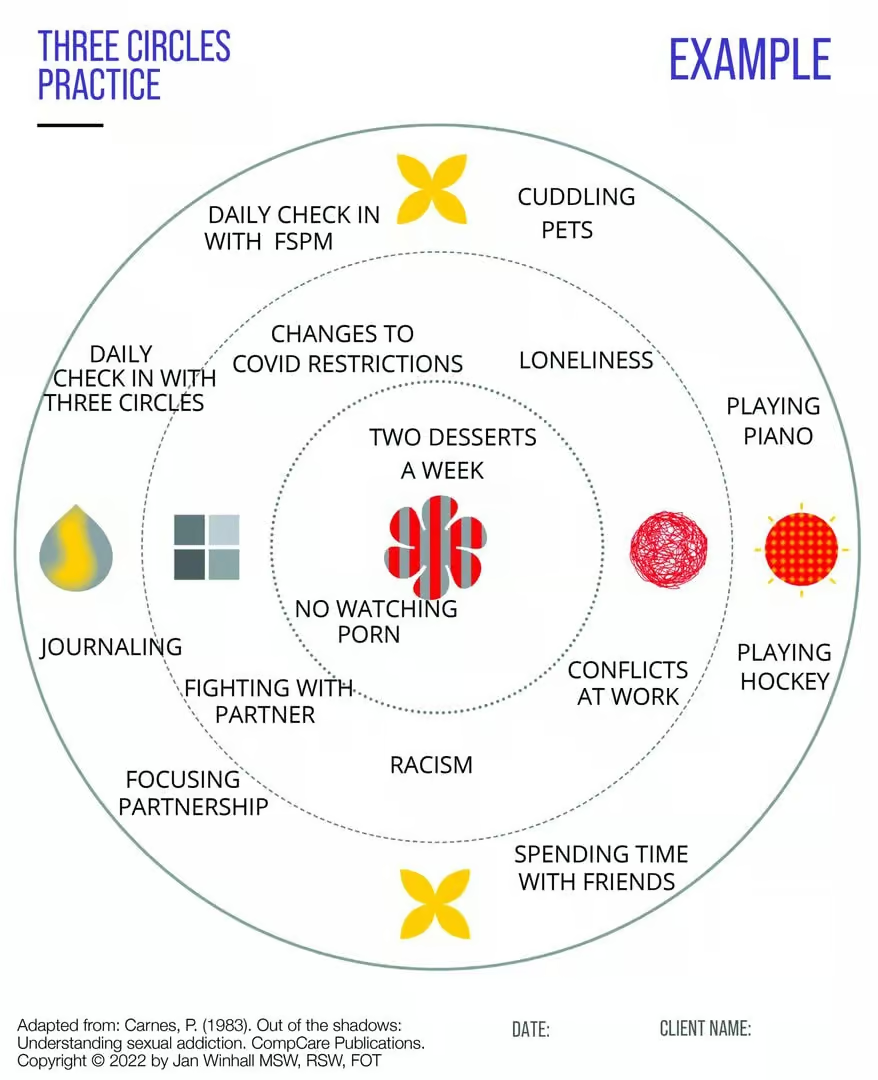
THREE CIRCLES TOOL
The Three Circles tool is a core concept in sex addiction recovery, particularly within 12-step recovery programs like Sex Addicts Anonymous (SAA) and Sex and Love Addicts Anonymous (SLAA). Its purpose is to help individuals clearly define and maintain sexual sobriety by identifying behaviors to avoid, be cautious of, and cultivate for a healthy recovery. It offers structure, awareness, and accountability.
Here’s how it works:
🔴 Inner Circle (Bottom Line Behaviors)
Purpose: Defines what sobriety means for the individual.
These are the compulsive, addictive, or destructive sexual behaviors the person is committed to abstaining from—such as watching pornography, using sex workers, infidelity, compulsive masturbation, or other sexually self-destructive acts.
Engaging in any of these behaviors is considered a relapse.
🟡 Middle Circle (Boundary or Risk Behaviors)
Purpose: Increases awareness of slippery slopes and helps prevent relapse.
These are triggers, high-risk situations, or gray-area behaviors that may not be acting out yet but could lead there—like sexting, spending time alone on certain websites, isolating, or excessive fantasizing.
Monitoring these behaviors helps the person stay vigilant and intervene early.
🟢 Outer Circle (Top Line Behaviors)
Purpose: Encourages healthy, life-affirming alternatives to addiction.
These are the positive, recovery-supporting behaviors that foster connection, self-care, and emotional regulation—such as going to meetings, exercising, therapy, meditation, spending time with safe people, and pursuing hobbies.
These are acts of self-nurturing and living with integrity.
Why It’s Important:
- Provides clarity and structure for recovery.
- Helps distinguish between healthy and unhealthy behaviors.
- Empowers individuals to create a personalized sobriety plan.
- Serves as a daily check-in and accountability tool.
This visual and practical tool makes the often-complicated terrain of sexual behavior more manageable and measurable, promoting long-term sobriety and growth.
ChatGPT said:
An abstinence contract in sex addiction recovery serves as a foundational tool to help individuals clearly define and commit to their personal boundaries around sexual behavior. Its primary purpose is to provide structure, accountability, and clarity during the healing process.
Key Purposes of an Abstinence Contract:
- Establishes a Clear Definition of Sobriety
In sex addiction recovery, sobriety isn’t one-size-fits-all. The abstinence contract outlines specific behaviors the individual agrees to abstain from (e.g., pornography use, affairs, anonymous sex), and may also include healthy sexual behaviors that are permitted, depending on the person’s goals and relationship status. - Creates Accountability
Sharing the contract with a therapist, sponsor, or support group provides external accountability. It becomes a reference point for measuring progress and identifying relapse. - Supports Relapse Prevention
By defining “bottom-line” behaviors (i.e., addictive or destructive actions), the contract helps individuals recognize when they are approaching or crossing a boundary. This can trigger early interventions before a full relapse occurs. - Encourages Personal Responsibility
Writing and signing a contract empowers individuals to take ownership of their recovery. It is a tangible expression of their commitment to change. - Guides Treatment and Therapy
Therapists and group facilitators use the contract to help tailor treatment goals, interventions, and discussions to the specific needs of the individual. - Promotes Honesty and Integrity
In recovery, honesty is key. The contract helps foster an environment of openness, especially in group or partner settings, where sharing one’s boundaries supports trust-building.
In Summary:
An abstinence contract is more than a list of “do’s and don’ts”—it’s a personalized recovery plan that helps individuals define sexual sobriety, stay accountable, and build a foundation for long-term healing and healthy intimacy.
REACH OUT TO SUSAN ZOLA AT SUEZOLA@ME.COM FOR THE DOCUMENT PASSWORD TO THE ABSTINENCE CONTRACT DOCUMENT ABOVE
ACCOUNTABILITY CONTRACT
An accountability contract in sex addiction recovery is a written agreement that outlines how a person in recovery will stay transparent and responsible for their behaviors, thoughts, and commitments—especially regarding their recovery goals. Its core purpose is to build trust, promote honesty, and create a consistent system of support during the healing process.
Purpose of an Accountability Contract in Sex Addiction Recovery:
- Fosters Transparency and Honesty
Accountability is about being open about your thoughts, feelings, and actions—especially when you’re struggling. The contract encourages regular check-ins with trusted individuals (such as sponsors, therapists, or accountability partners), creating a culture of honesty. - Strengthens Support Systems
Recovery is not meant to be done alone. This contract defines who the person will be accountable to, how often they will check in, and what they will report (e.g., slips, triggers, urges, successes). - Helps Prevent Relapse
Knowing you must report behaviors or struggles can act as a deterrent to acting out. It also allows for early intervention when someone is headed toward risky territory, often called the “middle circle” in the Three Circles model. - Reinforces Daily Recovery Habits
Accountability contracts may include commitments such as attending meetings, journaling, engaging in healthy sexuality or self-care practices, or completing therapeutic assignments—all of which help sustain long-term sobriety. - Promotes Integrity and Responsibility
Recovery is a personal journey, but the contract encourages ownership over choices. It helps individuals take their healing seriously by committing to regular communication and follow-through. - Builds Trust in Relationships
For those in partnered relationships, accountability contracts (sometimes shared with a partner, when clinically appropriate) help rebuild broken trust by showing commitment to change and transparency.
In Summary:
An accountability contract is a proactive recovery tool designed to keep the individual engaged, supported, and responsible. It encourages transparency, provides structured support, and creates a clear framework for living in alignment with recovery goals. It’s a vital part of creating lasting behavioral change and healing trust—in oneself and with others.
Take the First Step
You don’t have to continue living in secrecy, chaos, or despair. Recovery is possible. Healing happens in community—with structure, safety, and the right kind of support.
AI, Porn/Sex Addiction, and Chatbot Compulsivity: A Betrayal Trauma-Informed Perspective
Artificial intelligence is rapidly reshaping how people access stimulation, comfort, and connection. For individuals impacted by betrayal trauma and compulsive sexual behavior—whether directly or through a partner—AI introduces a new layer of relational and behavioral risk. It can function not only as a tool, but also as a reinforcing system for avoidance, fantasy, and emotional substitution.
This includes AI chatbots, AI-generated sexual content, and conversational systems that blur the boundaries between emotional intimacy, erotic fantasy, and information seeking.
AI Chatbot Addiction: Escapism, Attachment, and Emotional Substitution
Research by Shen, Huang, Liang, Kim, and Yoon (“The AI Genie Phenomenon and Three Types of AI Chatbot Addiction”) describes three emerging patterns of problematic AI engagement: escapist roleplays, pseudosocial companions, and epistemic rabbit holes.
From a betrayal trauma lens, these patterns are clinically significant because they can mirror relational dynamics already present in systems impacted by secrecy, attachment disruption, and compulsive sexual behavior.
AI chatbot overuse may involve:
- Escapist roleplay that replaces emotional reality with controlled fantasy
- Pseudosocial attachment to a responsive but non-reciprocal “relationship”
- Compulsive information loops used to regulate anxiety or uncertainty
In trauma contexts, these patterns can function as emotional bypassing—reducing distress in the short term while reinforcing avoidance of relational repair, grief, and vulnerability.
AI and Porn/Sex Addiction: Escalation, Accessibility, and Fantasy Reinforcement
AI is also transforming sexual behavior patterns by increasing the accessibility, personalization, and interactivity of erotic content. For individuals struggling with compulsive sexual behavior, this can intensify existing cycles of addiction.
AI-enhanced sexual content may contribute to:
- Increased novelty-seeking and escalation of stimulation
- Reinforcement of fantasy-based sexual conditioning
- Greater secrecy and isolation due to private, always-available access
- Emotional detachment from real relational intimacy
- Difficulty tolerating boredom, frustration, or emotional discomfort without sexualized escape
For partners of sex addicts, this can add a layer of betrayal complexity: AI use may not fit traditional definitions of infidelity, yet can still involve secrecy, emotional investment, or sexualized engagement that undermines relational safety.
The Intersection: AI as a Reinforcing System in Relational Trauma
When AI chatbots and AI-generated sexual content intersect with compulsive sexual behavior or attachment injury, they can reinforce a shared underlying pattern: using digital systems to regulate emotional states that feel unsafe to experience in relationship.
This can create a cycle of:
- Emotional discomfort or attachment distress
→ AI engagement (sexual, relational, or informational)
→ Temporary relief or dissociation
→ Reduced relational engagement or avoidance
→ Increased isolation and emotional dependency on digital systems
For individuals healing from betrayal trauma, this cycle may feel familiar—mirroring dynamics of secrecy, fantasy, emotional unavailability, or relational disconnection.
Betrayal Trauma Considerations
From a clinical and attachment-based perspective, the key concern is not moralizing AI or sexual behavior, but understanding function:
- Is AI use replacing or avoiding real relational repair?
- Does it reinforce emotional isolation or secrecy?
- Is sexualized AI content escalating compulsive patterns?
- Does chatbot use provide attachment soothing without reciprocal human connection?
- Is digital engagement interfering with grief, trust rebuilding, or embodied healing?
For partners of sex addicts, these behaviors can also complicate recovery by blurring the boundaries of what constitutes betrayal, intimacy, and emotional fidelity in the digital age.
Clinical Frame: What Healing Requires
Healing from betrayal trauma and compulsive sexual behavior typically requires:
- Rebuilding safe, reciprocal human connection
- Tolerating emotional distress without escape into fantasy or stimulation
- Developing embodied regulation skills (not purely cognitive or digital)
- Restoring trust, accountability, and relational transparency
AI systems can support learning and reflection—but when they become primary sources of emotional regulation, attachment, or sexual stimulation, they may unintentionally reinforce the very patterns recovery is trying to heal.
Reference
Shen, M. K., Huang, J., Liang, O., Kim, I.-J., & Yoon, D. (n.d.). The AI Genie Phenomenon and Three Types of AI Chatbot Addiction: Escapist Roleplays, Pseudosocial Companions, and Epistemic Rabbit Holes. University of British Columbia; Georgia Institute of Technology; Korea Institute of Science and Technology.
AI and Porn/Sex Addiction Recovery
AI can be a useful adjunct in recovery work, but it needs to be framed carefully: it’s a support tool, not a substitute for human connection, clinical care, or accountability structures. In addiction recovery—especially sex/porn addiction and betrayal trauma work—AI is most helpful when it strengthens insight, regulation, and connection rather than replacing them.
Here are some clinically grounded ways AI can be used in recovery:
1. Emotional Regulation Support (Between Sessions, Not Instead of Them)
AI can help individuals identify and name emotional states in real time, which is often a first step in interrupting compulsive cycles.
Examples include:
- Identifying triggers (“What was I feeling right before the urge increased?”)
- Labeling emotions (shame, loneliness, anxiety, anger, numbness)
- Grounding exercises or brief mindfulness prompts
- Helping slow down impulsive decision-making
This is most effective when paired with real-world coping skills (therapy, sponsor, group, somatic tools), not as the sole regulation system.
2. Cognitive Reflection and Pattern Recognition
AI can help users reflect on behavioral cycles in a structured way, which supports insight-building in recovery.
For example:
- Mapping trigger → thought → behavior → consequence loops
- Identifying rationalizations (“just this once,” “I deserve it,” “it doesn’t matter”)
- Exploring attachment patterns (avoidance, anxious pursuit, emotional numbing)
- Tracking relational patterns connected to compulsive behavior
This can be especially useful for increasing awareness between therapy sessions.
3. Support for Betrayal Trauma Processing (For Partners)
For partners of sex addicts, AI may be used as a supplemental reflection tool to:
- Organize thoughts and emotions after disclosure or discovery
- Help articulate questions for therapy or support groups
- Validate emotional responses (confusion, grief, anger, hypervigilance)
- Clarify boundaries or needs in written form
Importantly, AI should never replace relational support systems that provide attunement, containment, and accountability.
4. Communication Practice and Boundary Setting
AI can help individuals rehearse difficult conversations, especially early in recovery when shame or fear can block expression.
Examples:
- Writing boundary statements (“If X happens, I will…”)
- Practicing disclosure language in a structured way
- Preparing for couples therapy conversations
- Reframing reactive communication into regulated expression
This can reduce avoidance while strengthening relational clarity.
5. Psychoeducation and Normalization of Recovery Processes
AI can provide accessible explanations of:
- Addiction cycles (sexual, relational, behavioral)
- Trauma responses (fight/flight/freeze/fawn)
- Attachment dynamics
- Betrayal trauma symptoms
- Recovery stages (stabilization, mourning, integration)
This can help reduce shame and confusion, especially early in recovery.
6. Tracking Patterns Over Time
Used intentionally, AI can help summarize:
- Triggers across the week
- Emotional volatility patterns
- Relapse warning signs
- Progress markers (increased awareness, longer pause before acting, reaching out for support)
This works best when paired with real tracking tools (journals, apps, therapy homework).
Clinical Cautions (Important in Addiction & Betrayal Trauma Work)
AI becomes risky when it shifts from support to substitution. Red flags include:
- Using AI instead of reaching out to real people
- Emotional reliance on AI for soothing attachment needs
- Using AI for sexual stimulation or fantasy reinforcement
- Compulsive questioning loops (“just one more explanation”)
- Replacing therapy, groups, or sponsor relationships
In both addiction and betrayal trauma recovery, healing depends on real relational repair, not simulated or isolated regulation.
Bottom Line
AI can function as a bridge tool in recovery: helping people slow down, reflect, and organize experience. But it is not a replacement for the core healing agents in recovery, safe relationships, accountability, embodied emotional processing, and consistent human support.
RESOURCES
Podcast Episodes:
Articles:
Wired Article – Confessions of a Recovering AI Porn Addict by Jason Parham – August 1st, 2025
Pornography Addiction – Debra Kaplan Counseling – Pornography Addiction in the Age of AI
AI and Pornography: the next mental health crisis by Paracelsus Recovery
Internet and Technology Addicts Anonymous – Recovering from AI Addiction
Support Groups/Support:
Internet and Technology Addicts Anonymous