
Voices of Betrayed Partners
Real Stories. Shared Pain. Collective Healing.
You Are Not Alone
Betrayal by a partner struggling with pornography, compulsive sexual behavior, sex addiction, infidelity, or sexual secrecy can be profoundly destabilizing.
Discovery may leave you questioning what was real, what you can trust, and how much of your relationship you truly understood. You may find yourself questioning your memories, your intuition, your worth, your body, your relationship, or even your own perception of reality.
For many betrayed partners, the pain extends far beyond discovering a sexual or romantic behavior. The secrecy, deception, denial, omissions, gaslighting, repeated discoveries, or broken promises surrounding the behavior can create a profound loss of emotional and relational safety.
You may experience anger, grief, fear, confusion, anxiety, hypervigilance, numbness, sadness, or an overwhelming need to understand what happened.
You may feel as though the life you believed you were living suddenly changed.
And because sexual betrayal can carry so much shame and stigma, many betrayed partners suffer quietly—afraid that others will not understand the depth of what they are experiencing.
But you are not alone.
The stories shared here represent people who have experienced betrayal and chosen to put words to experiences that can be extraordinarily difficult to describe.
These voices are honest, vulnerable, courageous, and deeply human.
By reading and sharing these stories, we affirm:
What happened matters.
The impact matters.
Your experience matters.
Your voice matters.
Why Stories Matter
Validation
One of the most painful parts of betrayal can be wondering whether your reactions are somehow excessive.
Hearing another person describe feelings, thoughts, fears, or experiences similar to your own can provide an important reminder:
You are not alone in what you are feeling.
Someone else’s story may give language to an experience you have struggled to explain.
Connection
Shame thrives in secrecy and isolation.
Stories remind us that other people have experienced the confusion, grief, anger, fear, and uncertainty that can accompany betrayal.
Connection does not erase pain, but it can make pain feel less lonely.
Reclaiming Your Voice
Betrayal sometimes involves long periods of secrecy, denial, minimization, manipulation, or gaslighting.
A betrayed partner may have been told:
“You’re imagining things.”
“You’re overreacting.”
“Nothing is going on.”
“You’re too sensitive.”
Over time, experiences like these can make someone question their own instincts and perceptions.
Telling your story can be one way of reclaiming your ability to say:
This happened.
This affected me.
This is what my experience was.
Making Meaning
Writing does not require you to have everything figured out.
Sometimes the process of putting an experience into words helps organize events, emotions, memories, and questions that have felt chaotic.
Your story may evolve as your healing evolves.
What you understand today may be different from what you understand six months or several years from now.
Both perspectives are valid parts of your experience.
Helping Someone Else Feel Less Alone
A person newly discovering betrayal may feel as though no one could possibly understand what they are experiencing.
Then they encounter someone else’s story.
They recognize themselves in a sentence.
A feeling suddenly has a name.
A reaction they thought was abnormal begins to make sense.
Your story may become that moment for someone else.
There Is No “Right” Betrayal Story
Every experience of betrayal is different.
Your story may involve:
- Pornography use
- Compulsive sexual behavior
- Affairs
- Emotional affairs
- Online sexual behavior
- Sexting or messaging
- Dating apps
- Secret accounts or devices
- Sex workers or paid sexual content
- Repeated deception
- Financial secrecy related to sexual behavior
- Staggered or partial disclosures
- Gaslighting
- DARVO
- Broken recovery agreements
- Multiple discoveries
- Years of unexplained relationship difficulties
Some betrayed partners discover everything suddenly.
Others uncover information slowly over months or years.
Some remain in their relationships.
Some separate.
Some reconcile.
Some eventually decide to leave.
Some do not yet know what they want.
There is no required ending to your story.
Your Story Does Not Have to Protect Anyone Else
Betrayed partners sometimes become accustomed to protecting everyone around them.
You may have worried about protecting:
- Your partner
- Your children
- Your family
- Your relationship
- Your reputation
- Your partner’s reputation
- Other people’s opinions
- The appearance that everything is okay
This space is intended to center your experience.
You are allowed to acknowledge what betrayal has cost you.
You are allowed to describe anger alongside love.
You are allowed to describe grief alongside hope.
You are allowed to be uncertain.
You are allowed to have complicated feelings.
Healing does not require simplifying your experience.
Share Your Voice
Have you experienced betrayal connected to pornography, sex addiction, compulsive sexual behavior, infidelity, or sexual secrecy?
You do not need to be a writer.
You do not need to tell your entire story.
You do not need to have reached forgiveness, reconciliation, acceptance, or closure.
You can simply tell the truth about your experience.
Your story can:
- Help another betrayed partner feel less alone
- Put words to experiences others may not yet know how to describe
- Validate emotions that have been minimized or misunderstood
- Break the silence surrounding sexual betrayal
- Help you organize and process your own experience
- Reclaim a voice that may have been diminished through secrecy or deception
- Create connection with others who understand
- Offer hope without pretending that healing is simple
If You Are Not Sure What to Write
You may want to begin with one of these prompts:
The moment I realized something was wrong…
The day I discovered the betrayal…
What hurt me most was…
What I wish people understood about betrayal is…
The secrecy affected me by…
I began questioning myself when…
What I needed but did not receive was…
The hardest part of recovery has been…
Something I lost because of the betrayal was…
Something I have learned about myself is…
A boundary I learned I needed was…
What I would tell someone experiencing betrayal for the first time is…
Today, healing means…
Your contribution can be a traditional story, journal entry, reflection, poem, letter, or short passage.
A Compassionate Community
We believe betrayed partners deserve:
- Truth over secrecy
- Validation over judgment
- Empathy over blame
- Safety over pressure
- Accountability over excuses
- Support over silence
- Choice over expectations
- Time to heal without being rushed
Betrayed partners should not have to minimize their experiences in order to protect the comfort of others.
Their voices deserve to be heard in conversations about pornography, compulsive sexual behavior, infidelity, sex addiction, disclosure, recovery, and relationship repair.
Recovery conversations must include not only the experience of the person who acted out, but also the experience of the person who lived with the consequences of those choices.
Healing Does Not Require Reconciliation
Healing and reconciliation are not the same thing.
A betrayed partner can heal whether the relationship continues or ends.
Some couples may eventually rebuild trust and create a different relationship together. Others may determine that separation is necessary for their well-being.
Neither path determines whether healing has occurred.
The betrayed partner has the right to decide:
- What boundaries they need
- What information they need
- Whether they participate in couples recovery
- Whether they remain in the relationship
- What forgiveness means to them
- Whether forgiveness is part of their healing at all
- How quickly or slowly they move through the recovery process
There is no universal timeline for recovering from betrayal.
Your Story Belongs to You
Sharing your experience should always remain your choice.
No betrayed partner should feel pressured to publicly tell their story, forgive, reconcile, disclose personal details, or use their experience to educate others.
For some people, speaking openly can be empowering.
For others, privacy is an important form of safety.
Both choices deserve respect.
If you choose to share your story here, identifying information can be removed and your contribution can be published anonymously.
A Note to Readers
The experiences shared on this page represent the perspectives of individual betrayed partners.
Every relationship, recovery process, and experience of betrayal is different. These personal stories are not intended to diagnose another person, prescribe a particular course of treatment, or tell another betrayed partner whether they should stay, leave, forgive, or reconcile.
Instead, they offer something equally important:
Witnessing.
They allow one person to say:
This is what happened to me.
And another person to respond:
I understand. I have felt something like that too.
Sometimes healing begins with knowing that someone else understands.
A Public Voice: Maddie Corman
“I had to go on stage and re-live the most painful moments of my life. But that’s also where I started to reclaim my power.”
Actress and playwright Maddie Corman courageously shared her journey as a betrayed partner through her autobiographical one-woman play, “Accidentally Brave.” After discovering her husband’s secret life involving illegal sexual behavior, Maddie faced public scrutiny, profound personal betrayal, and the collapse of the life she thought she knew.
Instead of hiding, she chose to tell the truth.
“Accidentally Brave” doesn’t glamorize healing—it reveals the messy, honest, and often lonely reality of surviving betrayal while parenting, grieving, and finding your voice again.
Her story has resonated deeply with betrayed partners because:
- She didn’t have all the answers.
- She did feel anger, fear, and shame.
- She kept going—one brave act at a time.
Maddie’s vulnerability reminds us:
You don’t need to be perfect to be powerful. You just need to be real.
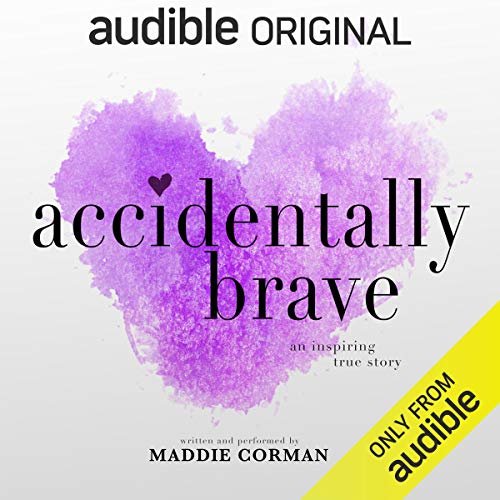
AudioBook from Audible – Accidentally Brave
- By: Maddie Corman
- Narrated by: Maddie Corman
- Length: 1 hr and 30 mins
Listen to Audiobook HERE
Courageous, daring, and unflinchingly honest, ACCIDENTALLY BRAVE is an inspiring true story about discovering a new normal when the familiar world falls apart, a must-see examination of what it means to navigate a world with no certainty. Maddie Corman’s profoundly personal play challenges perceptions, captivates audiences, and sparks an emotionally charged discussion that will leave you wondering: What would I do?
The unimaginable hits the home of Mrs. Corman. She’s left wondering, now what? Maddie candidly shares her deeply personal story of growth and healing through turmoil that could have easily destroyed her marriage and family. Maddie explains what happens when her husband’s long kept secret is revealed.
In this unflinchingly honest one-woman play, Maddie tells an inspiring true story about discovering a new normal when everything she thought she knew came undone. With raw vulnerability and unexpected humor, actress and playwright Maddie Corman delivers her story of perseverance and hope when the unthinkable tests her marriage, family, and values.
Originally Produced live by Daryl Roth
Original Theatrical Sound Design by Bart Fasbender
Original Music composed by Claire Wellin
Note: Accidentally Brave includes explicit language and discussion of adult themes. Discretion is advised.
“…[a] completely absorbing solo piece…about how the discovery of [Maddie Corman’s husband’s] secret affected her and what she decided to do about it for her own well-being, her kids’ well-being and yes, the well-being of her husband and of their marriage…Despite moments of expressing pure hatred for her husband, she doesn’t stop loving him. And there’s extraordinary power and bravery within her compassion, making ACCIDENTALLY BRAVE a truly uplifting experience…”
— BROADWAYWORLD.COM
You Matter. Your Voice Matters.
🌿 There is strength in your story. Even the broken pieces can become beautiful.
Voice of a Betrayed Partner – “Sex Addiction”
“Sex Addiction – Voice of a Betrayed Partner” is a raw and powerful expression of the devastation caused by sexual addiction from the perspective of the betrayed spouse. Written as a direct address to the addiction itself, it captures the deep pain, confusion, anger, and grief that follow betrayal.
Through vivid imagery and emotional honesty, the writer exposes how sex addiction deceives, destroys trust, and consumes relationships—turning love and safety into fear and chaos. It’s a voice of mourning for a life and marriage lost, yet also a declaration of awareness and strength.
This piece gives voice to countless partners who have been wounded by secrecy and betrayal, offering validation to their pain and the first steps toward reclaiming truth, healing, and hope.
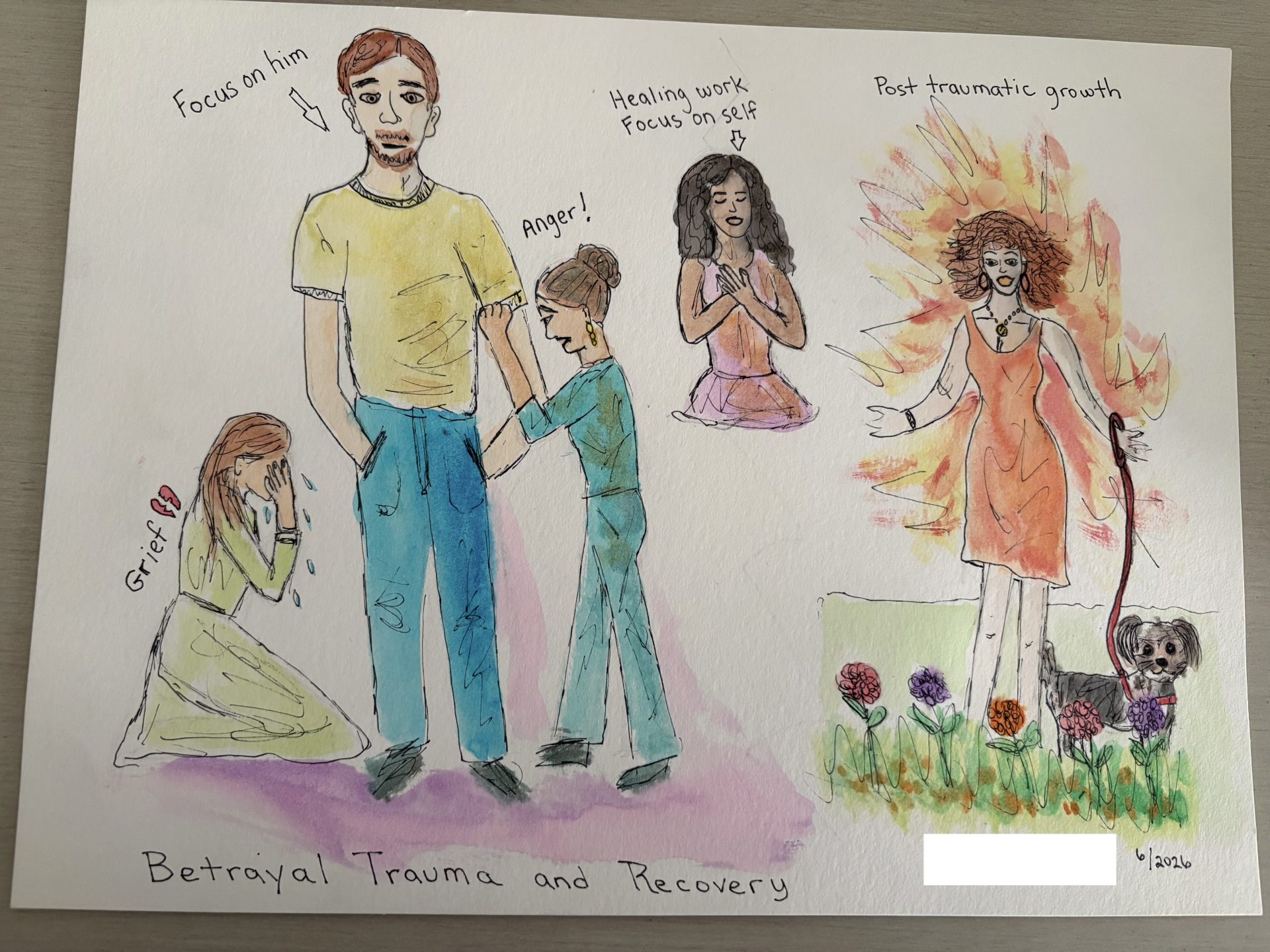
Voice of a Betrayed Partner – “Betrayal Trauma and Recovery”
“Betrayal Trauma and Recovery” is a visual journey through the emotional landscape of a betrayed partner healing from the wounds of relational and sexual betrayal. Through watercolor imagery and symbolic stages of recovery, the artwork portrays the painful transformation from devastation to empowerment.
On the left, the betrayed partner is consumed by grief, her attention fixed on the partner who caused the harm. Anger emerges as a natural response to betrayal, representing the awakening of boundaries and the recognition of deep emotional wounds. The central figures illustrate a pivotal shift—turning away from obsessing over the betrayer and redirecting energy toward healing, self-discovery, and personal restoration.
As the journey progresses, the focus moves inward. Through healing work, self-compassion, and courageous self-reflection, the betrayed partner begins reclaiming her identity beyond the trauma. The final image embodies post-traumatic growth: a woman standing confidently amid vibrant colors, symbolizing resilience, transformation, and renewed vitality. Accompanied by a loyal companion and surrounded by blooming flowers, she represents hope, freedom, and the possibility of creating a meaningful life after profound pain.
This artwork honors the complex reality of betrayal trauma—the grief, rage, confusion, and loss—while also illuminating the strength that emerges through recovery. It serves as a reminder that healing is not about forgetting what happened, but about reclaiming oneself, finding purpose, and growing beyond the trauma.
Resources for Sharing Your Story
Real Stories. Shared Pain. Collective Healing.
There is no single “right” way to tell the story of betrayal.
For some people, words come easily. For others, the experience may feel too complicated, overwhelming, fragmented, or emotional to put into a traditional written narrative.
Your story can be expressed through writing, drawing, painting, collage, poetry, photography, music, journaling, or other forms of creative expression.
Creative work can provide another language for experiences that may be difficult to explain.
You do not need to consider yourself an artist or writer. The purpose is not to create something polished or perfect.
The purpose is to give your experience somewhere to go.
Writing
Writing can help organize thoughts, memories, emotions, and questions that may feel scattered after betrayal.
You might write:
- A personal story
- A journal entry
- A letter you never intend to send
- A letter to your younger self
- A letter to the person you were before discovery
- A letter to your future self
- A reflection on Discovery Day
- A description of what betrayal felt like
- A list of things you lost
- A list of things you are reclaiming
- A poem
- A short essay
- A stream-of-consciousness reflection
- A message to another betrayed partner
- A statement beginning with, “What I wish people understood is…”
You do not need to tell your entire story.
Sometimes one moment, one feeling, or one truth is enough.
Drawing and Painting
Some experiences are easier to express visually than verbally.
You might draw or paint:
- What betrayal feels like
- What safety feels like
- Your life before and after discovery
- Your emotional landscape
- Your anger
- Your grief
- Your boundaries
- Your healing
- The version of yourself you are becoming
- What trust looks like now
- What freedom looks like
- A place where you feel safe
Your artwork can be abstract.
Colors, shapes, lines, textures, and symbols can communicate emotions without requiring an explanation.
Collage
Collage can be especially helpful when it is difficult to find your own words.
Using magazines, printed images, photographs, fabric, words, quotes, or other materials, you might create a collage representing:
- Before Betrayal
- Discovery
- What Was Hidden
- What I Lost
- What I Know Now
- What I Need
- My Boundaries
- Who I Am Becoming
- What Healing Looks Like
- My Future
You can also create two contrasting images:
What betrayal felt like
and
What healing feels like.
Poetry
Poetry allows emotion to exist without needing to explain everything.
Your poem does not need to rhyme or follow any particular structure.
You might begin with:
I remember…
I didn’t know…
You told me…
My body knew…
After I found out…
I lost…
I needed…
I am angry because…
I am grieving…
I am learning…
I choose…
I am becoming…
Sometimes a few lines can communicate what pages of explanation cannot.
Photography
Photography can be another way to document healing.
You might photograph:
- Places that make you feel safe
- Objects that symbolize your experience
- Something broken
- Something being repaired
- Light and darkness
- Doors, windows, roads, or bridges
- Nature
- Your hands
- A meaningful object
- Something you are letting go of
- Something you are reclaiming
A photograph can stand alone or be paired with a few words describing what it represents.
Music and Playlists
Music can hold memories and emotions that may be difficult to access through conversation.
Consider creating playlists such as:
- Discovery
- Anger
- Grief
- What I Couldn’t Say
- Taking My Power Back
- Learning to Trust Myself
- Healing
- Starting Over
- Hope
- Who I Am Becoming
You might also write about why a particular song feels connected to your experience.
Letters You Do Not Have to Send
Not every letter needs a recipient.
You might write:
- A letter to your partner
- A letter to the betrayal
- A letter to your anger
- A letter to your body
- A letter to your intuition
- A letter to the person you were before discovery
- A letter to the person you are becoming
- A letter to someone who did not understand
- A letter to another betrayed partner
- A letter to yourself one year from now
The purpose is expression—not necessarily communication.
Body Mapping
Betrayal can be experienced physically as well as emotionally.
Using an outline of a body, you might identify where you notice:
- Fear
- Anger
- Grief
- Anxiety
- Numbness
- Shame
- Tension
- Safety
- Strength
- Relief
Colors, words, symbols, and images can be added to represent different sensations.
This can help connect emotional experiences with what is happening in the body.
Create a Betrayal Timeline
Sometimes betrayal creates confusion around memories and events.
A personal timeline may help organize your experience.
You might include:
- When you first sensed something was wrong
- Important discoveries
- Conversations you remember
- Disclosure events
- Significant relationship moments
- Times you questioned yourself
- Moments of clarity
- Important boundaries
- Turning points in recovery
- Moments when you began trusting yourself again
This timeline belongs to you. It does not need to prove anything to anyone else.
Before and After
Divide a page in half.
On one side:
Before I Knew
On the other:
After I Knew
You might explore:
- What you believed
- How you felt
- What you trusted
- What you feared
- What you understand now
- What has changed
- What you are rebuilding
What I Lost / What I Am Reclaiming
Create two lists.
What Betrayal Took From Me
and
What I Am Reclaiming
Your lists may include:
- Trust
- Safety
- Confidence
- Sexual security
- Identity
- Time
- Energy
- Friendships
- Financial stability
- Hope
And what you are reclaiming may include:
- My voice
- My intuition
- My body
- My boundaries
- My choices
- My independence
- My creativity
- My confidence
- My future
Create a Healing Box
Choose a box, container, folder, or digital collection where you can keep meaningful items from your healing process.
This might include:
- Letters
- Journal pages
- Artwork
- Photographs
- Quotes
- Cards
- Poems
- Objects that symbolize strength
- Reminders of important boundaries
- Notes from supportive people
- Evidence of your growth
Over time, the collection can become a visual record of your journey.
Create Without Explaining
Not everything you create needs to make sense to another person.
You are allowed to create something simply because it expresses what you feel.
You do not need to defend it.
You do not need to interpret it.
You do not need to share it.
Sometimes the act of making something is enough.
Sharing Your Creative Work
If you would like to contribute to Voices of Betrayed Partners, submissions may include:
- Personal stories
- Anonymous reflections
- Poems
- Letters
- Drawings
- Paintings
- Collages
- Photography
- Digital artwork
- Short written reflections paired with artwork
Creative submissions may be shared anonymously with permission.
Please avoid including identifying information about other individuals unless you have permission to do so.
A Gentle Reminder
Creative expression can sometimes bring unexpected emotions or memories to the surface.
You are always allowed to stop.
You are allowed to take a break.
You are allowed to create privately.
You are allowed to decide that something you made is not meant to be shared.
The purpose is not to produce something beautiful.
The purpose is to create a space where your experience can be acknowledged.
Your story does not have to look like anyone else’s story.
It can be written.
It can be drawn.
It can be painted.
It can be photographed.
It can be messy.
It can be unfinished.
It can be one sentence.
It can be one image.
It can simply be yours.